
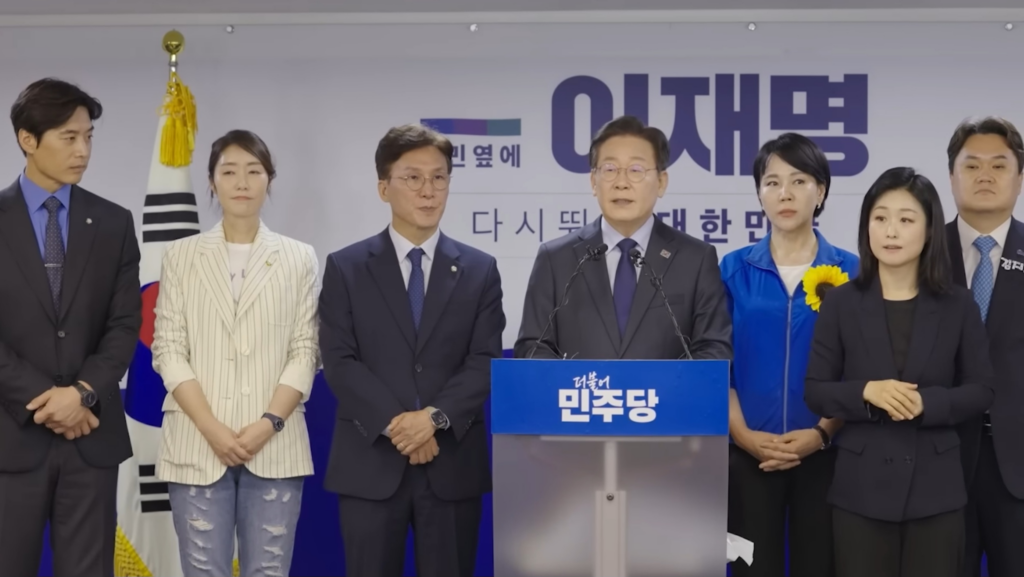
The Beginning of the DP’s Polling Woes
Last week we covered the recent challenges to the PPP and their failure to rebound following the short-lived martial law declaration in December of 2024. Lee Jae-myung and his Democratic Party (DP), who won the majority in the National Assembly in 2022 and the presidency earlier this year, have enjoyed an extended honeymoon phase with the South Korean public. Lee, after assuming the presidency, has benefited greatly from his charismatic charms and strong polling numbers, dating back to his time in the National Assembly. President Lee has enjoyed a high approval rating, even when compared to predecessors at this point in their term, but for the first time Lee’s polling numbers have started to fall. Lee began his term as president with rather strong polling numbers, despite a slew of pending legal cases. The Democratic Party’s reputation has been unphased by any negative news. The South Korean President and leader of South Korea’s Liberal Democratic Party have seemed to have the right responses at every turn, at least until recently. A series of scandals, resulting in various cabinet resignations, have rocked Lee’s administration. Lee’s administration is wrapped up in a new scandal seemingly every week, all while the Korean public continues to face serious issues with the economy and real estate. The fact that the corruption seen within the Lee administration tends to revolve around land development casts serious doubts on the abilities of the current government to address the nation’s most pressing issues.
Scandal, Corruption, & Land Development
Late October saw the resignation of Vice Minister for Land and Infrastructure, Lee Sang-kyeong, the first resignation at this level of the Lee administration. Lee Sang-kyeong submitted his resignation due to his comments on the housing market, links to corruption, as well as the government’s changes to real estate regulations. As Lee Jae-myung entered office, it was widely understood that real estate and housing would stand as a major area of concern, and the burgeoning Lee government faltered at the first hurdle. Not only has the Lee government been unable to bring the housing market under control, but Lee has not been able to recruit the talent necessary to tackle such complex issues. The policies have not only failed but former Vice Minister Lee has been caught in his own real estate scandal. Down the road, perhaps even during next year’s nationwide elections, Lee Sang-kyeong’s resignation will be seen as the first wisps of smoke from a larger fire.
Land development has been the one ghost that the Lee administration cannot shake. Housing costs have been on the rise and rental costs have hit all time highs earlier this year. Lee’s government has tried to tame housing costs. As many of those who are in the process of either searching or purchasing an additional property then scrambled to complete their purchases before the new changes, which subsequently sent shockwaves through the rental market as fewer properties became available. The intention of these changes was good, but the policymakers did not fully consider the ramifications or public sentiment surrounding such a hot-button issue.
Neofamilial Influence
The resignations continue as just a few weeks ago, we saw the resignation of Kim Nam-kuk, the Digital Communications Secretary, after allegations of influence peddling. The optics of Kim’s actions far out weight tangible harm done. This type of influence has been explored within South Korea, known as Neofamilialism. The idea behind Neofamilialism is that in the absence of a robust civil society, South Koreans turn to blood, hometown, and school ties for various forms of connection. While further work on Neofamilialism will be needed to understand the Korean society on a deeper level, Kim’s actions of peddling influence to other alumni of Chung-Ahn university fits a Neofamilial pattern. Lee has long turned towards his close group of advisors and colleagues, many of which date back to his days at the Judicial Research and Training institute. This group has long been described as the levee throughout various tides of Lee’s political career. When looking at Lee and his close group, you can see the proverbial high water mark through the group’s journey via their political careers. The group around Lee has stood by him and defended his actions through thick and thin, holding back the potential flood waters of scandals. But it would look as if Lee and his friends have finally met their match.
Unification Church Scandal
A new scandal involving the Unification church has emerged, and with it Lee’s first major dips in polling. The most recent polls show Lee at 54.3% approval rating, the first major dip since taking office. Lee has ordered a full investigation into the Unification Church. The headquarters have been raided relating to the investigation and the leader of the Unification Church, and the leader, Han Hak-ja, has been jailed and questioned. while the church itself has declined to make a statement regarding the investigation. The results of the investigation are yet to be seen, but the effects are starting to ripple through the DP and Lee’s administration.
The Unification Church is widely associated with the assasination of former Japanese Prime Minister, Shinzo Abe, but the Church has been active in South Korea and Japan since the 1950’s. While the Unification Church was recognized as a cult in the 1970s. By then, it had spread its ideas and beliefs about its founder, Moon Sun-myung, as far as the United States. The history of the Unification Church is fascinating and will be the subject of an upcoming piece here at the Vivarium Group, so please check back in and give it a read!
Lee’s honeymoon period with the South Korean public is coming to a close. The rising costs of living, a stagnating domestic economy, and a suite of foreign policy issues, are starting to weigh on Lee’s formerly stellar polling numbers. 2026 will see national elections in South Korea that will serve as a de facto referendum on Lee and his party. The clock is ticking down to next June, Lee will only have 6 months to prove to the public that he and his party are the right choice to lead South Korea.